Japan
Murasaki
The name Murasaki (紫) translates to "purple" as homage to the band's idols, Deep Purple . Murasaki were an influential band in Japan's '70s rock scene, credited in large part with creating the Okinawan rock scene as well as pioneering rock music in mainland Japan. Twins Toshio Shiroma , Masao Shiroma , and a third brother, Tsutomu Shiroma had a band called ピーナッツ in 1968. In 1970 George Murasaki asked Toshio and Masao if they would like to form a band and with the addition of Yukio Shimoji they formed Murasaki. Their self-titled debut as well as the album Impact achieved record setting sales at a time when rock music was just beginning to gain popularity in Japan. Murasaki initially built a name for themselves locally by performing for American troops stationed in Okinawa. 1975 saw Yamaha bring Murasaki in as a guest performer at their major band battle festival 8.8 Rock Day, where the band played to several thousand rock fans at the World Expo '70 park in Osaka. This was the biggest stage Murasaki would perform in their career. The performance went over so well that Murasaki were brought back in 1977 to play the same event. Murasaki were given a special feature on a full side of 8.8 Rock Day '75's double-vinyl live album. In 1978, Murasaki disbanded and George Murasaki formed the band George Murasaki & Mariner, which included Hiroto Arasaki who years later would become Murasaki's vocalist. This group ended up releasing two albums and a single before disbanding. In 1983, Murasaki played a reunion show and recorded a live album titled Why Now? Peaceful Love Rock Concert , which spawned the Peaceful Love Rock Festival that has run annually for over thirty consecutive years, and in 1992 Murasaki had the honor of opening for the Ian Gillan Band. In the late '70s at the height of their influence and popularity in Japan, George Murasaki was voted the best rock keyboardist in Japan and Eiichi "Chibi" Miyanaga the 3rd best rock drummer in a poll conducted by a mainland rock magazine, and several years later a contest sponsored by the popular Young Guitar magazine searching for the best young guitarist in Japan, which was judged by Yngwie J. Malmsteen , out of over 700 entrants. Yngwie ended up choosing Keiichi Sato as the winner. The band played a combination of hard rock and progressive rock in their early years and upon reforming in 2007, their sound became significantly heavier and more metallic with the addition of Hiroto Arasaki , who George Murasaki had worked with in the past. Played reunion shows in 1983, 1992, 1994, 1997, and 1998. In 1999 George Murasaki and Eiichi "Chibi" Miyanaga announced they would be reforming Murasaki, and they played another reunion show in 2000 with a new line-up which featured two of George Murasaki's sons. On August 8, 2020 Murasaki played a show commemorating the 45th anniversary of their 8.8 Rock Day performance. Their show included a segment called Murasaki classic where the band played their full set from the 1975 gig, with Eiichi Miyanaga on lead vocals before the band later played modern material with Hiroto Arasaki joining in. Opening for the band was George Murasaki's sons with their band 8 Ball. In 2022 a documentary entitled "紫 〜伝説のロック・スピリッツ〜" was made about the history of Murasaki and their importance to the development of Japanese hard rock and heavy metal. Artists who were interviewed in the documentary included Minoru Niihara , Hironobu Kageyama , Pata , Demon Kakka , Damian Hamada and others. Compilation Appearances: - "Devil Woman" "Do What You Want" "Double Dealing Woman" "Highway Star" on V/A - 75 8・8 Rock Day (Bourbon, 2xLp, 1975) - "Double Dealing Woman" "On Wings of Love" "Blackout" "Doomsday", "Take You on a Ride" "Woman from Tokyo" on Okinawan Hard Rock Legendry (Teichiku, CD, 2003)
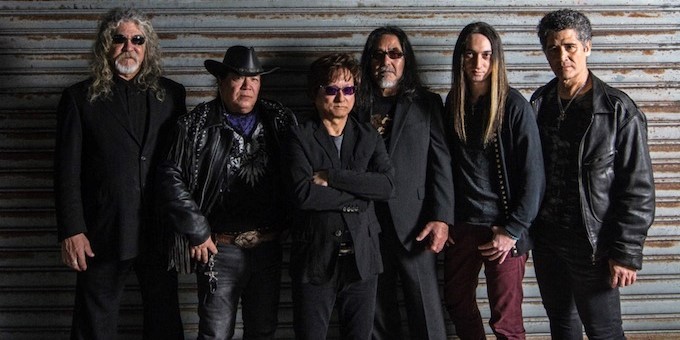
Lineup
George Murasaki
Keyboards
1970-1978, 2000, 2007-present
GG
Guitars
1971-1978, 2007-present
Chibi
Drums, Vocals (backing) (1972-1974, 1975-1978, 2007-present), Vocals (lead)
2000
Kiyomasa Higa
Guitars
1973-1978, 2007-present
Chris
Bass
2007-present
JJ
Vocals (lead)
2007-present
Toshio Shiroma
Bass
1970-1978
Tsutomu Shiroma
Guitars
1970-1972
Masao Shiroma
Vocals (lead)
1970-1978
Kuniyoshi Shigetoshi
Drums
1974-1975
Ray Murasaki
Bass
2000
Leon Murasaki
Drums
2000
Keiichi Sato
Guitars
2000
Leon Murasaki
Drums
2026-present
Keiichi Sato
Guitars
2026-present
Discography
The Very Best of Murasaki - 2010 to 2016
compilation · 2025
Timeless
full-length · 2023
Quasar
full-length · 2016
Eyes Wide Open
ep · 2013
琉神マブヤー1972 Legend
single · 2012
Purplessence
full-length · 2010
Murasaki
boxed set · 2007
Golden Best
compilation · 2005
Back to the Roots
live album · 1998
Bourbon Perfect Box
split · 1988
Why Now...?
live album · 1983
Bourbon Spirits Live
live album · 1983
Murasaki Forever - Murasaki Best Collection
compilation · 1979
Starship
compilation · 1978
Starship Rock'n Rollers
single · 1978
Doin' Our Thing at the Live House
live album · 1977
Rock'n'Roll Singer
single · 1977
Impact
full-length · 1977
Free / Do What You Want
single · 1976
Events
No upcoming events yet.